The four zones, in the order food moves
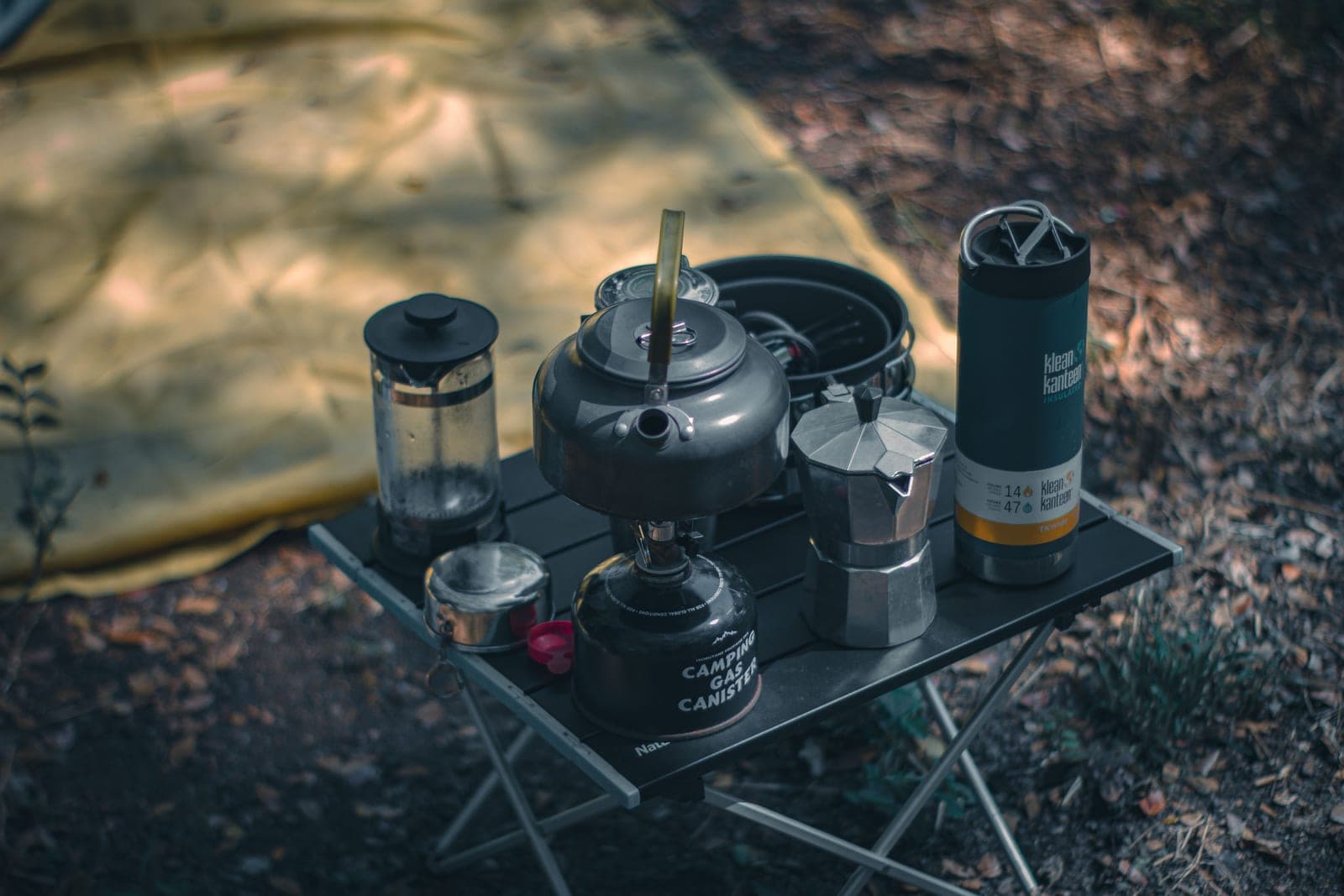
A good camp kitchen setup is a short assembly line. Food comes out of the cooler, gets cut and seasoned on a prep surface, goes onto the stove, gets eaten at the table, and the dishes end up in a wash station. Put the zones in that order and nobody walks a hot pan past the cooler or carries raw chicken across the dining table.
At a frontcountry campground, the National Park Service notes that cooking “takes place at the picnic table and fire ring/grate,” and its advice is to set the area up so you have room to work. The picnic table is your dining table. What it lacks is a surface at standing height for prep and a surface that is meant to sit under a lit stove. Those two jobs are what camp kitchen furniture is for, and they are where most setups go wrong.
| Zone | What it needs | Furniture that does the job |
|---|---|---|
| Cold | Shade, a closed lid, 40°F or below | The cooler itself, at the start of the line |
| Prep | A wipeable surface near standing height, beside the stove | Lifetime 80387 at its 34-inch setting; the prep tops on the Coleman Pack-Away Kitchen (33.75 in) and GCI Master Cook Station (32.3 in) |
| Cook | A top the maker rates for heat, and a load rating above your loaded stove | GCI Slim-Fold and Master Cook Stations (heat-rated aluminum, 48 lb); Kamp-Rite Kwik Pantry (aluminum cook table with windshield, 70 lb) |
| Wash | Three bins, hot water, a way to strain and carry off the gray water | GCI Master's collapsible sink; Camp Chef Sherpa's organizer lined for use as a sink |
The cook zone: put the stove on a top rated for it
The single most important question in a camp kitchen is one most buyers never ask: does the maker say this surface can hold a lit stove? Some do, in writing. GCI Outdoor describes the Slim-Fold Cook Station's heat-resistant aluminum top as ideal for supporting camp stoves, griddles and hot cookware, and says the Master Cook Station's top is built to handle high heat from grills, stoves or hot cookware. Kamp-Rite builds the Kwik Pantry around a roll-out aluminum tabletop with a detachable windshield for use with a camp stove.
Others don't, and the silence matters. Lifetime publishes no heat rating for the HDPE top on its 80387 folding table. Camp Chef's Sherpa has an aluminum roll-top, but Camp Chef publishes no stove or heat rating for it; the divider inside is for carrying a stove, not running one. Coleman says the Pack-Away Kitchen's side table accommodates most Coleman stoves, yet Coleman Consumer Care also says a 22-inch Blackstone griddle overhangs that side table by about 3 inches. If the maker hasn't said a top can take heat, treat it as a prep or serving surface.
Then check the load. GCI rates the main top on both cook stations to 48 lb (the Slim-Fold's four side tables are rated to 30 lb each, and the lower racks to 35 lb). Kamp-Rite rates the Kwik Pantry to 70 lb. A two-burner stove or a tabletop griddle with a full fuel bottle and a cast-iron pan on it is a real load, so weigh your cooking setup on a bathroom scale before you trust a 48 lb top with it. If you cook on a griddle most nights, our griddle table picks for camping compare what each stand's maker does and doesn't publish.
The prep zone: standing height, wipeable, beside the stove
Most camp tables are built for sitting. The ALPS Camp Table stands 27 inches high and the ALPS Dining Table XL 28, which is fine for a plate and a camp chair and hard on your back for 20 minutes of chopping. The camp kitchens in our registry put the prep surface higher: 33.75 inches on the Coleman Pack-Away Kitchen (per Coleman Consumer Care), 33 inches on the Kamp-Rite Kwik Pantry, 32.3 inches on the GCI Master Cook Station. The GCI Slim-Fold stays at 28 inches and the Camp Chef Sherpa at a 29-inch working height.
An adjustable table can do both jobs. The Lifetime 80387 sets to 24, 29 or 34 inches, and its 48 x 24-inch top is listed at 1,500 lb evenly distributed on the Target listing sold by Lifetime. It is a prep and serving table, not a stove stand: no heat rating is published for the HDPE top. To match a prep surface to your own elbows rather than an average, use our camping table height guide, which works from a published ergonomics rule.
The cold zone: 40°F and the two-hour clock
Clemson Cooperative Extension's camping food-safety sheet sets the numbers: chilled foods held at 40°F or below, frozen foods at 0°F or below. Bacteria multiply quickly between 40°F and 140°F, and perishable food should not sit out of the cooler for more than two hours, or more than one hour when it is above 90°F outside. The same sheet says to keep raw meat, poultry, shellfish and eggs separate from ready-to-eat food and to pack raw foods in plastic bags so their juices can't reach anything else.
In a camp kitchen that means the cooler sits at the head of the line, in the shade, with the lid shut between trips to it. Take out only what goes on the stove next. The Park Service adds a practical trick: eat the foods that need to stay cold, such as meat and cheese, first, so you don't need to buy more ice later in the trip. Pack a food thermometer too; Clemson lists 165°F for poultry and 160°F for ground meat.
The wash zone: three bins and 200 feet
The Park Service describes the three-bin method: wash cookware and utensils in warm water in the first bin, rinse them in warm water in the second, then rinse again in a third bin with a bleach solution of 2 teaspoons of bleach per gallon of water. Clemson adds hand washing for at least 20 seconds with warm water and soap before and after handling food, and warns against cooking with or drinking water straight from a stream or lake.
For the gray water, the U.S. Fish & Wildlife Service's Leave No Trace guidance is to carry wash water 200 feet away from streams or lakes, use small amounts of biodegradable soap, and scatter strained dishwater. Where a campground designates a place for gray water, use it. A built-in sink helps here: the GCI Master Cook Station has a collapsible soft-shell sink with a drain, and one of the Camp Chef Sherpa's organizers is lined for use as a sink or a cooler.
Between trips: keep it packed
The kitchen you actually use is the one that lives packed and ready. That is the whole argument for a chuck box, the wooden kitchen cupboard that opens into a work surface, and our chuck box guide covers when one still makes sense and when a folding kitchen replaces it. The folding cook stations are built for storage: the GCI Slim-Fold folds to 3.7 inches thick in one piece, the GCI Master to 5.9 inches deep, and the Coleman Pack-Away Kitchen's prep surface doubles as its own storage case.
What to look for in camp kitchen furniture
- A heat rating in writing. GCI and Kamp-Rite say their aluminum tops are for stoves. If the maker is silent, the top is for prep.
- A published load rating above your loaded stove. GCI's main tops are rated to 48 lb and the Kwik Pantry to 70 lb; Coleman publishes no load rating for the Pack-Away Kitchen at all.
- A prep surface near standing height. The standing-height kitchens we score put it between 32.3 and 33.75 inches; most dining tables we score sit at 27 to 29.
- Wind protection and storage. Kamp-Rite includes a detachable windshield; GCI adds a 35 lb lower rack; the Kwik Pantry has six zippered shelves and the Sherpa four zippered compartments.
- A warranty longer than a season, and parts. GCI gives its cook stations a 3-year limited warranty and offers a limited selection of parts on request. Coleman, Camp Chef and Kamp-Rite give 1 year and list no parts for these models. No camp kitchen in our registry scores above 5.6 on our Built-to-Last scale, because none pairs a long warranty with a listed wear part.
Three pieces worth buying once
Our picks for this
A cook station, a kitchen with a sink, and a prep table
Two cook stations whose tops GCI rates for heat, and the adjustable table with the highest listed load in our tables registry, to use for prep.
- Stock photo
Best compact cook station
GCI Outdoor Slim-Fold Cook Station
3-yr warranty5.6/10Heat-rated aluminum top (48 lb), four 30 lb side tables and a 35 lb rack, folding to 3.7 inches thick. 3-year limited warranty.
Check price on Amazon#ad · Price set by Amazon · Disclosure for the link to GCI Outdoor Slim-Fold Cook Station
- Stock photo
Best camp kitchen with a sink
GCI Outdoor Master Cook Station
3-yr warranty5.4/10Adds a collapsible sink with drain and a lantern pole at a 32.3-inch standing height. Same 48 lb heat-rated top and 3-year term.
Check price on Amazon#ad · Price set by Amazon · Disclosure for the link to GCI Outdoor Master Cook Station
- Stock photo

Best adjustable-height camp table
Lifetime 4-Foot Adjustable Height Folding Table (80387)
10-yr warranty7.2/10The prep table: 24, 29 or 34 inches, 1,500 lb evenly distributed (Lifetime-sold Target listing), 10-year limited. No heat rating, so keep the stove off it.
Check price on Amazon#ad · Price set by Amazon · Disclosure for the link to Lifetime 4-Foot Adjustable Height Folding Table (80387)
The Slim-Fold scores 5.6 and the Master 5.4; the Master's sink and lantern pole cost you 3.5 lb and nothing on the warranty. For the full field, including the Kamp-Rite Kwik Pantry and Camp Chef Sherpa, see our best camp kitchen tables, and the GCI Slim-Fold Cook Station review for what its 48 lb rating does and doesn't cover. Every table, stand and kitchen we score is on the camp tables and kitchens hub.
How we scored this
Products we claim to have tested: 0
Plenty of sites say they sat in every chair on the list for a season. We don't say that, and we say so on every page. What we do instead: read the maker's rated capacity, frame, fabric, dimensions and weight; quote the warranty from the maker's own warranty page with the date we read it; check whether seat fabric, cot canvas, feet, valves and legs are sold as replacement parts; and score all of it on a published rubric where durability and warranty carry half the weight. Every spec links to where it came from.
Scores are computed from that documented research with fixed bands, not lab results. Commissions never set a score or decide a pick. The rubric and its bands are published.
Questions
Frequently asked
How do you set up a camp kitchen?
Line up four zones in the order food moves: a cooler in the shade, a prep surface near standing height, a stove on a top the maker rates for heat, and a three-bin wash station at the end. Keep the stove outdoors.
Can you put a camp stove on a plastic or laminate table?
Only if the maker says the top can take it. Lifetime publishes no heat rating for the 80387's HDPE top, and Camp Chef publishes none for the Sherpa's roll-top. GCI and Kamp-Rite say their aluminum tops are for stoves.
Is it safe to use a camp stove inside a tent?
No. The CDC says never to use a portable gas camp stove indoors, because carbon monoxide from burning fuel is an odorless, colorless gas that kills without warning.
How long can food sit out at a campsite?
Clemson Cooperative Extension says perishable food should not be unrefrigerated for more than two hours, or more than one hour when it is above 90°F outside. Keep chilled food at 40°F or below.
How do you wash dishes when camping?
Use three bins: warm wash water, a warm rinse, and a final rinse with 2 teaspoons of bleach per gallon, as the National Park Service describes. Carry wash water 200 feet from streams or lakes and scatter strained dishwater.
How much weight can a camp kitchen table hold?
It depends on the maker's figure. GCI rates the main top on its Slim-Fold and Master Cook Stations to 48 lb, Kamp-Rite rates the Kwik Pantry to 70 lb, and Coleman publishes no load rating for the Pack-Away Kitchen.
Keep reading
Related on Seat & Stake
- Best camp kitchen tablesEvery cook station and camp kitchen we score, ranked.
- Best griddle tables for campingStands and stations for a tabletop griddle.
- Camping table height guideDining, prep and cooking heights, matched to your chair and elbows.
- Chuck box guideThe packed-and-ready kitchen box, and when a folding kitchen replaces it.
- GCI Slim-Fold Cook Station reviewWhat a 48 lb heat-rated top covers.
- How we scoreThe Built-to-Last rubric for tables and kitchens.
Receipts
Sources
- GCI Outdoor — Slim-Fold Cook Station product page (read 2026-09-22)
- GCI Outdoor — Master Cook Station product page (read 2026-09-22)
- GCI Outdoor — Consumer Warranty Information (Tables, Chairs & Cook Stations: 3 Year Limited) (read 2026-09-22)
- GCI Outdoor — Warranty Policy hub (limited selection of replacement parts) (read 2026-09-22)
- Kamp-Rite — Kwik Pantry with Cook Table (KPT172) product page (read 2026-09-22)
- Kamp-Rite — Warranty & Returns page (read 2026-09-22)
- Kamp-Rite — Accessories & Replacement Parts listing (read 2026-09-22)
- Camp Chef — Sherpa Table & Organizer product page (read 2026-09-22)
- Camp Chef — Sherpa Camp Table and Kitchen Organizer instructions (0311-MSTAB-Instructions), PDF hosted by dealer OpticsPlanet (read 2026-09-22)
- Camp Chef — Product Warranty page, coverage chart (read 2026-09-22)
- Coleman — Pack-Away Folding Camp Kitchen product page incl. Coleman Consumer Care answers (Wayback capture 2026-09-05) (read 2026-09-22)
- Coleman — Limited Warranty Information, warranted products chart (Tables: 1 year) (Wayback capture 2026-07-27) (read 2026-09-22)
- Lifetime — 4-Foot Adjustable Height Table (Commercial), 80387 product page (read 2026-09-22)
- Target — Lifetime 4' Adjustable Height Commercial Grade Table (80387), sold and shipped by Lifetime (read 2026-09-22)
- Lifetime — Order Replacement Parts (customer service) page (read 2026-09-22)
- ALPS Mountaineering — Camp Table product page (read 2026-09-22)
- ALPS Mountaineering — XL Dining Table product page (read 2026-09-22)
- Clemson Cooperative Extension, Home & Garden Information Center — HGIC 3887, Food Safety for Camping (Faith C. Isreal and Karen E. Jackson, April 14, 2022) (read 2026-09-22)
- CDC — Carbon Monoxide Poisoning Basics (read 2026-09-22)
- National Park Service — Cooking in Camp (read 2026-09-22)
- National Park Service — Propane Canister Safety for Campers (last updated July 17, 2018) (read 2026-09-22)
- U.S. Fish & Wildlife Service — Leave No Trace Principles (read 2026-09-22)
We don't claim to have tested, owned or sat in these products. Products we claim to have tested: 0. Specs and rated capacities come from the maker's own product pages (or a named dealer's copy when the maker's site blocked us), warranty terms from the maker's warranty page with the date we read it, and any third-party observation is attributed to whoever made it. Amazon prices change often, so we don't print them. Where a figure isn't published, we say so and it scores zero. Read the full method.