Why a camp chair hurts your back, specifically
A standard quad camping chair is a fabric sling hung between four legs. Sit in it and the fabric stretches into a hammock shape: the deepest point of the sag sits under your tailbone, which means your hips end up lower than your knees and your pelvis rotates backwards. When your pelvis rolls back, the natural inward curve of your lower spine flattens out and then reverses, and the discs and ligaments at the base of your spine take load they are not shaped to take. That is the ache, and it is a geometry problem rather than a comfort problem — which is why a thicker cushion does not fix it.
Two other things compound it. A low seat makes the pelvic tilt worse, because the lower you sit relative to your knee height the further back your hips roll. And a short backrest supports nothing above your mid-back, so you slump forward to get comfortable and your neck pays for it. Those are the three variables, and all three are published numbers you can read before you buy.
The three specs that predict it
1. Seat height
The single most useful number. A seat around 18 inches off the ground keeps your hips roughly level with your knees, which keeps your pelvis neutral; a seat at 14 or 15 inches does not. Both of the lumbar-support chairs we score publish 18 inches (STRONGBACK Elite and the KingCamp lumbar chair). The lowest chairs in our registry sit at 14.5 inches, which is the zero-gravity lane — a reclined 14.5-inch seat is fine for your back because you are lying back, but an upright one is not. Every seat height we have is collected in best high-seat camping chairs.
2. Whether the maker states lumbar support
“Padded back” is not lumbar support. Lumbar support means something physically occupies the gap behind the small of your back so your spine cannot flatten into it. Two makers in our registry state it explicitly: STRONGBACK describes a patented frame-integrated lumbar support with a padded lumbar cushion on the Elite, and KingCamp lists lumbar support with a padded back and seat on its Oversized chair. That wording — support built into the frame rather than foam glued to a sling — is the distinction worth paying for.
3. Back height, and whether the seat is a sling or a panel
A back that reaches your shoulder blades lets you sit upright without recruiting your lower back to hold you there. The published figures on the three picks below are 36.5 in, 37.9 in and 38.8 in overall, with GCI publishing a 24-inch backrest specifically. And a seat panel stretched between rigid rails — a director's-chair geometry — sags far less than a one-piece sling, which is a large part of why those chairs feel different. We compare the two shapes in camping chair vs director's chair.
Who should be careful, and who should not worry
- Anyone sitting for more than about an hour at a stretch. Sports parents, anglers, festival campers. Short sits in a cheap chair are not the problem; three hours is.
- Anyone who finds standing up from a low chair hard. The getting-up motion out of a sagging 15-inch seat loads your lower back at its worst mechanical disadvantage. A higher seat and rigid armrests remove that moment entirely.
- Anyone with an existing lumbar problem. The chairs that state frame-integrated lumbar support exist for you, and they are the one case where paying four times the price of a basic quad chair is easy to justify.
- Probably not: occasional campers in a decent chair. A chair with an 18-to-19-inch seat and a back above 36 inches, used for an evening around a fire, is unlikely to be the cause of anything.
What to look for before you buy
In order: a published seat height of 18 inches or more; the words “lumbar support” in the maker's own description, not a retailer's; an overall height above about 36 inches so the back reaches your shoulders; rigid rather than fabric armrests, so you push up on the chair instead of with your back; and a published rated capacity with real headroom over your weight, because a chair loaded near its limit sags more. The three chairs below are the ones in our registry that satisfy the first three, and here is how they compare.
Three chairs that fix it
Our picks for this
Three camp chairs built around your lower back
One purpose-built, one budget, one that rocks. All three publish a seat height and a back tall enough to matter.
Best camp chair for a bad back
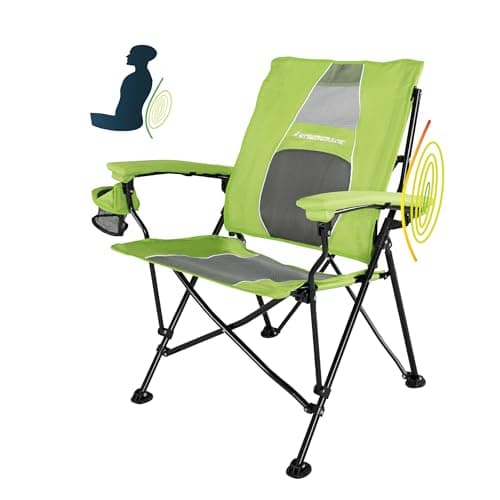
STRONGBACK Elite Camping Chair
2-yr warranty6.6/10The only chair we score built around the problem: STRONGBACK's patented frame-integrated lumbar support plus a padded lumbar cushion, an 18-inch seat, a 23-inch seat width, 600D polyester, steel-framed armrests, 300 lb, 11.9 lb. Warranty is 3-year limited direct and 2-year on Amazon purchases, with fabric at 1 year.
$159.95Amazon#ad · Price as of October 10, 2026 · Disclosure for the link to STRONGBACK Elite Camping Chair
- Stock photo
Best budget lumbar-support chair
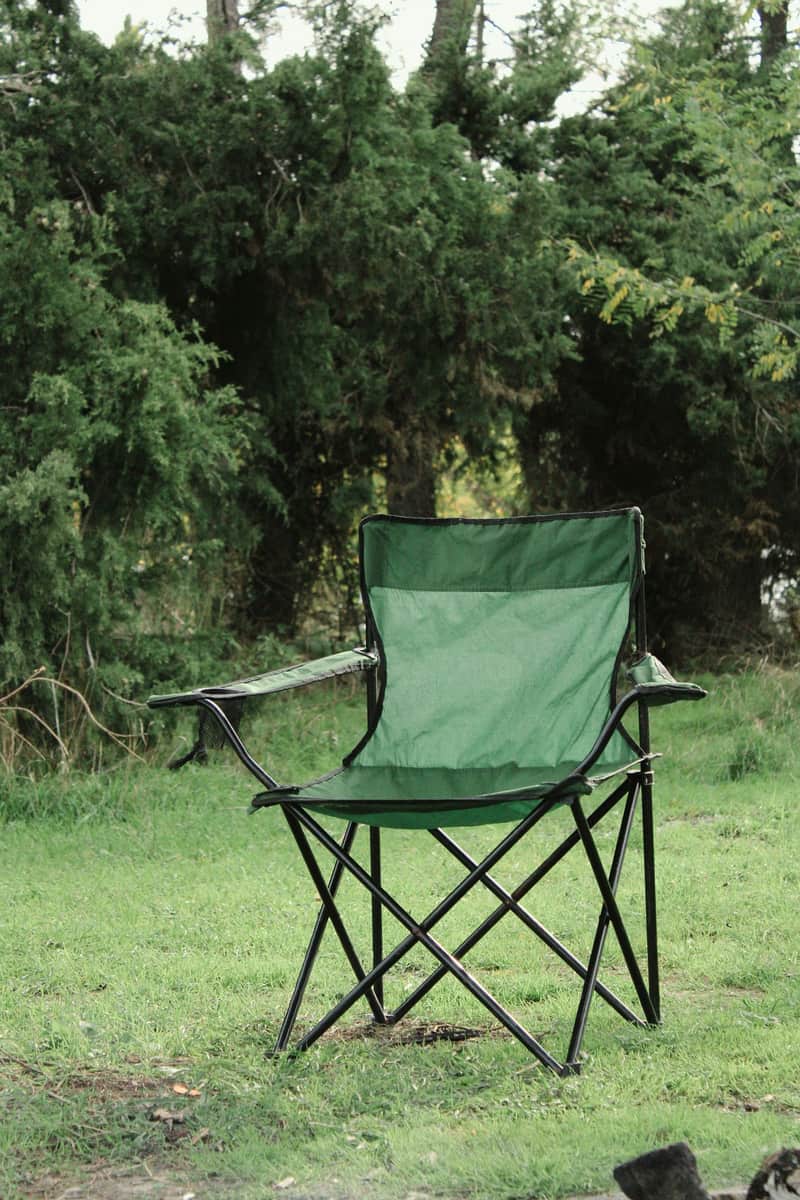
KingCamp Oversized Lumbar Support Camping Chair
1-yr warranty5.4/10The budget version of the same idea: KingCamp states lumbar support with a padded back and seat, an 18-inch seat, a 37.9-inch overall height and adjustable wide armrests, 300 lb at 13 lb. Twelve-month warranty and no parts listed.
Check price on Amazon#ad · Price as of October 10, 2026 · Disclosure for the link to KingCamp Oversized Lumbar Support Camping Chair
Best tall-back rocker
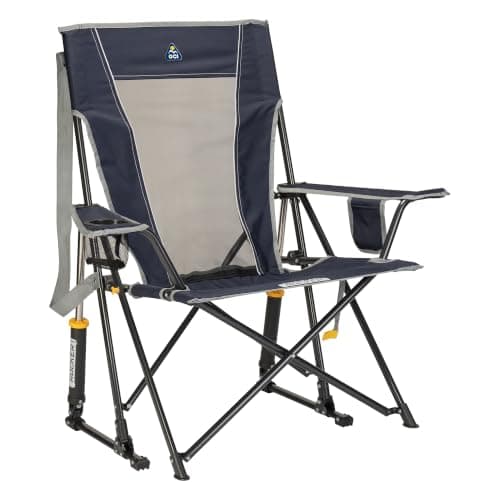
GCI Outdoor Comfort Pro Rocker
3-yr warranty5.4/10For anyone whose back prefers to keep moving: GCI's spring-action rocking frame under a 24-inch tall angled backrest, a 17.5-inch seat and a 38.8-inch overall height, 250 lb at 11.0 lb, with GCI's 3-year written warranty.
$75.00Amazon#ad · Price as of October 10, 2026 · Disclosure for the link to GCI Outdoor Comfort Pro Rocker
If you want the full ranking rather than three picks, the dedicated pages are best camping chairs for bad backs and, for the reclined answer, zero gravity chairs for back pain. Reclining is genuinely a different mechanism: lying back at 30 degrees or more transfers your upper-body weight into the backrest instead of down through your lumbar spine, which is why a good zero-gravity chair can feel better than a good upright one even with a 14.5-inch seat.
Fixes for the chair you already own
- Put something in the lumbar gap. A rolled towel, a jacket or a small camp pillow behind the small of your back restores the curve and costs nothing. This is the single highest-return change you can make and it works in any sling chair.
- Raise the seat. Sitting on a folded blanket or a cot pad lifts your hips relative to your knees and reduces the backward pelvic tilt. Crude, and it works.
- Stop the chair sinking. On soft grass a quad chair's feet sink unevenly, which tilts the seat and makes the sag worse. Pads under the feet fix it — see how to stop camping chairs sinking in grass.
- Get up every 45 minutes. Unglamorous, free, and more effective than any chair on this page. Static loading is the real problem; the chair just decides how uncomfortable static is.
- Check the seat fabric has not stretched. An old sling sags far more than a new one, and at that point the chair genuinely has become bad for your back. If the fabric has gone, repairing or replacing the seat is cheaper than a new chair on the handful of models whose makers sell the part.
One last thing worth knowing: if you sleep at camp as well as sit, the sleeping surface probably matters more than the chair. A sagging air mattress does to your spine overnight what a sagging sling does in an afternoon, and we rank the firm, foam-core options in best camping mattresses for back pain and the cot equivalents in best camping cots for bad backs.
How we scored this
What goes into every pick
We read the maker's rated capacity, frame, fabric, dimensions and weight; quote the warranty from the maker's own warranty page with the date we read it; check whether seat fabric, cot canvas, feet, valves and legs are sold as replacement parts; and score all of it on a published rubric where durability and warranty carry half the weight. Every spec links to where it came from, and the live Amazon price sits in the button.
Scores are computed from that documented research with fixed bands, so two products are always measured the same way. Commissions never set a score or decide a pick. The rubric and its bands are published.
Corrections & updates
- First published. Specs quoted from existing registry records; no product specs were changed.
Questions
Frequently asked
Are camping chairs bad for your back?
Not inherently, but most are badly shaped for it. A one-piece sling seat sags into a hammock under you, which rolls your pelvis backwards and flattens your lower spine — that is the ache people describe. A chair with a seat 18 inches or higher, a maker-stated lumbar support and a back above about 36 inches avoids it.
What makes a camping chair good for your lower back?
Three published specs: seat height (18 inches or more keeps your hips level with your knees), explicit lumbar support from the maker rather than a retailer, and a backrest tall enough to reach your shoulder blades. Rigid armrests help a fourth way, by letting you push up on the chair instead of with your back.
Is a zero-gravity chair better for your back than a camping chair?
For sitting still for a long time, often yes — reclining past about 30 degrees transfers your upper-body weight into the backrest rather than down through your lumbar spine, and the chairs that publish a sliding pillow let you put support exactly where you want it. The trade is a 14.5-inch seat, which makes standing up harder.
How can I make my camping chair better for my back without buying a new one?
Put a rolled towel or small pillow in the gap behind your lower back; that single change restores the lumbar curve the sling removes. Then sit on a folded blanket to raise the seat, stop the feet sinking unevenly on soft ground, and get up every 45 minutes.
Does a padded camping chair help your back?
Not much on its own. Padding changes how the contact feels; it does not stop the sling sagging or your pelvis tilting. That is why we score a maker-stated, frame-integrated lumbar support differently from “padded back” — one changes the geometry, the other changes the surface.
Which camping chair is best if I already have back problems?
The STRONGBACK Elite is the only chair in our registry designed around the problem: a patented frame-integrated lumbar support plus a padded lumbar cushion, an 18-inch seat, a 23-inch seat width and steel-framed armrests, rated to 300 lb. If a diagnosed condition is involved, ask your physiotherapist before you take a spec sheet's word for anything.
Keep reading
Related on Seat & Stake
- Best camping chairs for bad backsThe full ranking, not just three picks.
- Best zero gravity chairs for back painThe reclined answer, and why it works differently.
- Best high-seat camping chairsEvery seat height we have, in one table.
- Camping chair vs director's chairWhy a flat seat panel sags less than a sling.
- Best camping mattresses for back painIf you sleep at camp too, this matters more than the chair.
Receipts
Sources
- STRONGBACK — STRONGBACK Elite product page and specifications (read 2026-09-22)
- STRONGBACK — Strongback Chair Guarantee (3-year direct, 2-year Amazon, fabric 1 year) (read 2026-09-22)
- STRONGBACK — Elite Camping Chair Carry Bag (replacement bag) (read 2026-09-22)
- KingCamp — Oversized Lumbar Support Camping Chair product page and tech specs (read 2026-09-22)
- KingCamp — KingCamp Warranty Information (outdoor chairs: 12 months; post-warranty repair plan) (read 2026-09-22)
- GCI Outdoor — Comfort Pro Rocker product page and spec comparison chart (read 2026-09-22)
- GCI Outdoor — Consumer Warranty Information (3-year limited warranty, exclusions, claim fees) (read 2026-09-22)
- GCI Outdoor — Carry Strap/Handle replacement part (read 2026-09-22)
- Outdoor Life — Best Camping Chairs for Bad Backs, updated Apr 26, 2024 (per-product warranty terms as reported) (read 2026-09-22)
Specs and rated capacities come from the maker's own product pages (or a named dealer's copy when the maker's site blocked us), warranty terms from the maker's warranty page with the date we read it, and any third-party observation is attributed to whoever made it. Prices come live from Amazon with the date they were read. Where a figure isn't published, we say so and it scores zero. Read the full method.