Why compression is the problem
A self-inflating mat is a sealed envelope around an open-cell foam core. Exped publishes a 16 kg/m³ open-cell polyurethane foam for the MegaMat; Therm-a-Rest publishes StrataCore urethane foam on the MondoKing 3D; Sea to Summit publishes polyurethane foam in an Air Frame construction; ALPS publishes a Jet Stream open-cell hexagon-cored foam in the Flexcore. All of them work the same way: open the valve, the compressed foam springs back to its own thickness, and air is pulled in behind it. That spring is the entire mechanism.
Leave the foam compressed in a stuff sack for months at a time and the cell walls take a set. The mat still holds air, but it stops inflating itself properly — you find yourself blowing it up or using the pump sack for a mat that used to need neither, and it never quite reaches its published thickness again. There is no repair for it, because nothing has broken: the foam has simply been trained into a smaller shape.
How to store one, step by step
- Open the valve and let it fully self-inflate. Give it an hour on the floor. You want the foam at its full published thickness — 4.25 inches for a MondoKing 3D, 3.9 for a MegaMat, 5.9 for a MegaMat Max, 4 for a Comfort Deluxe, 2 for a Flexcore — before you do anything else.
- Wipe both faces and let it dry completely. Damp cloth, mild soap if it needs it, then several hours of air. Both the outside and, if it has been wet inside, the inside — see below.
- Leave the valve open. All of it: the MondoKing has a two-valve TwinLock system, the MegaMat has two flat valves, the Flexcore XL has double brass valves. Open every one.
- Store it flat, or loosely rolled. Flat under a bed or on top of a wardrobe is ideal. If you have to roll it, roll it loosely with no strap and no sack — a roll you can push a fist into is fine.
- Keep the stuff sack somewhere else. The sack is for the trip. Storing the mat in the sack is the mistake this entire guide exists to prevent, and most people make it because the sack is right there.
- Hang it if you have nowhere flat. Over a rafter or a wide hanger, valve open, so nothing is pressing on the foam. Avoid hanging it from a single point for years; the fabric does not like a permanent stress concentration.
Where to put it
- Dry. A damp basement grows mildew inside the valve and in the seams, and the smell does not come out of a foam core.
- Dark. UV degrades the TPU laminates and polyester shells these mats are built from — Exped and Sea to Summit both publish TPU-laminated fabrics. A mat stored in a sunlit conservatory ages faster than one used twenty nights a year.
- Cool and stable. Not against a furnace, a hot water tank, or directly under an uninsulated garage roof. Heat cycles are hard on adhesive seams and on the foam.
- Off a concrete floor. Concrete wicks moisture up into whatever sits on it. A shelf or a pallet solves it.
- Away from rodents. A mouse nest in a foam core ends the mat. Stored clean and in a hard container, or high up, is the practical answer.
Drying it first, properly
Outside damp is easy. Inside damp is the one people miss, and it happens every time you inflate a mat by mouth — breath carries moisture straight into the foam, where it has nowhere to go.
- Inflate it with the pump sack, not your lungs, whenever you can. Every mat here ships with one: Exped includes a Top-Up Pump, Therm-a-Rest includes a pump/stuff sack, and Sea to Summit's Airstream HV pump sack doubles as the stuff sack.
- If it has been mouth-inflated for a week, dry the inside at the end of the season. Open the valve, roll the mat from the closed end to push the moist air out, let it self-inflate with dry room air, and repeat two or three times. Then leave it open and flat for a day.
- Never put heat into it. No hairdryer, no radiator, no sun. Warm air into a sealed foam envelope is how you delaminate a seam.
The valve, and why it stays open
Two reasons. The foam cannot sit at full loft with the valve shut and some air short — it will be held slightly compressed for the whole storage period. And a sealed mat traps whatever humidity was inside it when you closed it, for months.
The valve is also the part you cannot replace. Exped lists no replacement valve for either MegaMat. Therm-a-Rest sells Permanent Home and Instant Field repair kits but lists no replacement for the MondoKing's TwinLock valve, routing valve problems to its warranty and repair team. Sea to Summit lists no valve or patch kit online at all — parts come by request through its warranty and spare-part form. ALPS sells a Flexcore Repair Kit with two 2-inch patches and adhesive, and no valve. So: a puncture is fixable by anyone, and a valve is a factory job. Treat the valve gently, do not overtighten it, and keep grit out of the threads.
Cot pads and plain foam pads
Not every camp mattress is self-inflating, and the rules differ:
- Cot pads with a removable cover — TETON's canvas camp pad, for instance — store best unrolled and flat, with the cover washed separately and fully dry before it goes back on.
- Closed-cell foam pads such as the Therm-a-Rest Z Lite SOL do not care about compression in the same way, because there is no air exchange and no valve. Store them flat or in their accordion fold; keep them out of sun.
- Air mattresses with an internal pump are a different product again: store them deflated, dry, loosely folded rather than tightly creased along the same lines every time, because repeated hard creases are where the welds eventually fail.
The pad-by-pad rankings are in best cot pads and best sleeping pads for car camping.
Reviving a mat that has been squashed for years
Sometimes it works. The routine is slow and costs nothing:
- Unroll it, open every valve, and leave it alone on a flat floor for 48 hours at room temperature.
- Top it up gently with the pump sack — not your lungs — to full firmness, leave it inflated overnight, then open the valve and let it settle again. Repeat two or three times over a few days.
- Keep it flat and open for a couple of weeks before you judge the result.
If it still does not self-inflate to anything near its published thickness, the foam has taken a permanent set and the mat is now a manual-inflate pad. It will still insulate, because R-value comes mostly from the foam and the trapped air rather than from loft alone, but it will never feel new. That is the cost of the stuff sack.
What the warranties do and do not cover
- Therm-a-Rest: limited lifetime, with a repair-first policy — and Therm-a-Rest may repair damage the warranty does not cover for a reasonable fee, which is the single most useful sentence in any mattress warranty we have read.
- Sea to Summit: limited lifetime against manufacturing defects; spare parts and paid repairs via a request form, charged for labor and materials.
- Exped: five years on defects, a repair kit in the box, a Field Repair Kit sold separately, and repairs in Exped's own workshops including non-warranty damage for a nominal charge.
- ALPS Mountaineering: lifetime against defects in materials or workmanship, with the PVC air bed excepted at one year, plus a line-specific Flexcore Repair Kit.
Every one of those is a defects warranty. None of them is a “you stored it badly” warranty, and three of the four will nonetheless repair your own damage for a fee — which is a better outcome than most camp furniture offers, and still worse than not needing it.
Mats worth storing properly
Our picks for this
Four self-inflating mats, and what each maker will do for you later
Chosen on the published foam, the valve system and the repair route - the three things good storage is protecting.
Best overall camping mattress
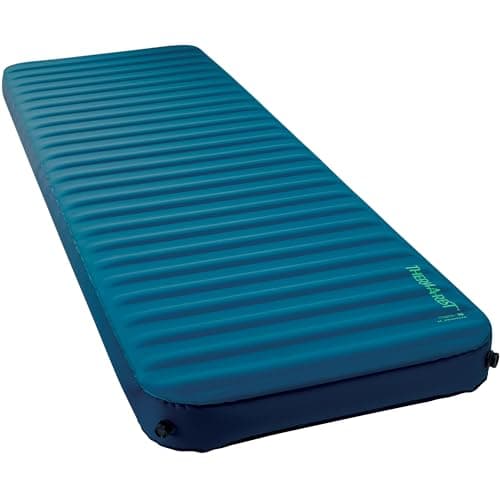
Therm-a-Rest MondoKing 3D Sleeping Pad (Large)
Lifetime warranty8.3/104.25 inches of StrataCore urethane foam, R-value 7, a 50D knit top over a 75D base, and a limited lifetime warranty with a repair-first policy - Therm-a-Rest may also repair non-warranty damage for a fee. Permanent Home and Instant Field repair kits are sold; the TwinLock valve is a factory job.
$258.22Amazon#ad · Price as of October 17, 2026 · Disclosure for the link to Therm-a-Rest MondoKing 3D Sleeping Pad (Large)
- Stock photo

Best for cold-weather car camping
Exped MegaMat Self-Inflating Mat (LXW)
5-yr warranty7.7/1010 cm (3.9 in) of 16 kg/m3 open-cell foam at an ASTM R-value of 8.1, with a Top-Up Pump and repair kit in the box and a Field Repair Kit sold separately. Five-year warranty, and Exped repairs mats in its own workshops including non-warranty damage for a nominal charge.
Check price on Amazon#ad · Price as of October 17, 2026 · Disclosure for the link to Exped MegaMat Self-Inflating Mat (LXW)
Best lifetime-warranty foam mattress
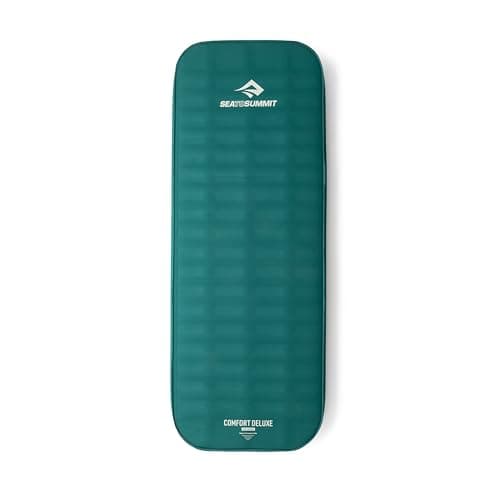
Sea to Summit Comfort Deluxe Self-Inflating Sleeping Pad
Lifetime warranty8.0/104 inches of polyurethane foam at an ASTM R-value of 7.7, with a stretch-knit top and a solution-dyed 75D TPU-laminated base. The Airstream HV pump sack doubles as the storage sack - so keep it for travel and store the mat out of it. Limited lifetime warranty, parts by request only.
$249.00Amazon#ad · Price as of October 17, 2026 · Disclosure for the link to Sea to Summit Comfort Deluxe Self-Inflating Sleeping Pad
- Stock photo
Best budget cot-width self-inflating pad
ALPS Mountaineering Flexcore Air Pad (X-Large)
Lifetime warranty6.0/10The budget cot-width option: 77 x 30 inches and 2 inches thick at R 2.9, with double brass valves on the XL and a lifetime warranty. ALPS is the only maker here with a patch kit named for this specific pad line: the Flexcore Repair Kit (7730083), two 2-inch patches and adhesive.
Check price on Amazon#ad · Price as of October 17, 2026 · Disclosure for the link to ALPS Mountaineering Flexcore Air Pad (X-Large)
How we scored this
What goes into every pick
We read the maker's rated capacity, frame, fabric, dimensions and weight; quote the warranty from the maker's own warranty page with the date we read it; check whether seat fabric, cot canvas, feet, valves and legs are sold as replacement parts; and score all of it on a published rubric where durability and warranty carry half the weight. Every spec links to where it came from, and the live Amazon price sits in the button.
Scores are computed from that documented research with fixed bands, so two products are always measured the same way. Commissions never set a score or decide a pick. The rubric and its bands are published.
Corrections & updates
- First published from the existing product records; no product specs were changed.
Questions
Frequently asked
How should you store a self-inflating mattress?
Unrolled and flat, or loosely rolled, with every valve open, somewhere dry, dark and cool. Never compressed in its stuff sack — the open-cell foam takes a permanent set and stops self-inflating properly, and no warranty covers that.
Should you leave the valve open when storing a sleeping pad?
Yes, all of them. An open valve lets the foam sit at its full loft and lets trapped humidity escape instead of sitting inside the mat for months. The MondoKing has two valves, the MegaMat has two, and the Flexcore XL has two brass ones — open every one.
Can you store a self-inflating mattress rolled up?
Loosely rolled with the valve open is acceptable if you have nowhere flat — a roll you can push a fist into. What ruins the foam is a tight roll in a compression sack with the valve shut, which is exactly how the mat came out of the box and exactly the wrong way to leave it for a year.
Why won't my self-inflating mattress inflate anymore?
Usually because it has been stored compressed and the foam has lost loft. Try reviving it: unroll it, open every valve and leave it flat for 48 hours, then inflate fully with the pump sack and release two or three times over a few days. If it still falls short of its published thickness, the set is permanent and you now have a manual-inflate pad. Rule out a leak first with the method in how to fix a camping mattress leak.
Can you store a camping mattress in the garage?
Only if it is dry, out of sunlight, off the concrete and away from heat and rodents. A garage usually fails at least two of those. Flat under a bed indoors costs nothing and is the single best place for a self-inflating mat.
Is it bad to inflate a self-inflating pad with your mouth?
For a top-up on one trip, no. As a habit, yes — breath puts moisture into the foam core where it cannot dry, which over time means mildew and smell. Use the pump sack that came with the mat, and dry the inside out at the end of the season by rolling the air out and letting it refill with dry room air a few times.
Keep reading
Related on Seat & Stake
- How to fix a camping mattress leakBefore you blame the foam, rule out a hole.
- Best camping mattressesThe self-inflating field, ranked on what lasts.
- Camping mattress R-value explainedWhy lost loft costs less warmth than you would think.
- How to clean a camping cotThe deck under the pad, and the same drying rules.
Receipts
Sources
- Therm-a-Rest (Cascade Designs) — MondoKing 3D Sleeping Pad, Large / XXLarge tech specs (read 2026-09-22)
- Therm-a-Rest (Cascade Designs) — Therm-a-Rest Warranty (limited lifetime; repair-first; fee-based repairs; repair videos and kits) (read 2026-09-22)
- Therm-a-Rest (Cascade Designs) — Permanent Home Repair Kit (read 2026-09-22)
- Therm-a-Rest (Cascade Designs) — Instant Field Repair Kit (read 2026-09-22)
- Therm-a-Rest (Cascade Designs) — Z Lite SOL Sleeping Pad, Small / Regular tech specs (read 2026-09-22)
- Exped — MegaMat product page, MW / LW / LXW specifications (read 2026-09-22)
- Exped — MegaMat Max product page, LXW specifications (read 2026-09-22)
- Exped — Warranty and repair (5-year warranty; repairs in Exped's own workshops) (read 2026-09-22)
- Exped — Field Repair Kit accessory page (read 2026-09-22)
- Exped — FAQs (patching a mat, repair videos, valve compatibility) (read 2026-09-22)
- Sea to Summit — Comfort Deluxe Self Inflating Sleeping Pad, Regular Wide / Large Wide / Double specs (read 2026-09-22)
- Sea to Summit — Warranty & Repair (limited lifetime; spare-part and repair requests) (read 2026-09-22)
- ALPS Mountaineering — Flexcore Air Pad, Regular / Long / X-Large specs (read 2026-09-22)
- ALPS Mountaineering — Air Pad Repair Kit (Flexcore Repair Kit 7730083) (read 2026-09-22)
- ALPS Mountaineering — Warranty (life of the product; PVC Air Bed 1 year) (read 2026-09-22)
- TETON — Canvas Camping Pads (Adventurer Regular / Universal XL / Outfitter XXL) product page (read 2026-09-22)
- TETON Help Center — Can I purchase a new camp pad cover? (read 2026-09-22)
- NEMO — Repairs (repair requests, spare parts by request) (read 2026-09-22)
Specs and rated capacities come from the maker's own product pages (or a named dealer's copy when the maker's site blocked us), warranty terms from the maker's warranty page with the date we read it, and any third-party observation is attributed to whoever made it. Prices come live from Amazon with the date they were read. Where a figure isn't published, we say so and it scores zero. Read the full method.