Diagnose it first — there are only four problems
“The cot is uncomfortable” is almost always one of these, and they need different answers.
- It sags in the middle. The deck fabric has stretched, or it was never tensioned properly. The hammock shape pushes your shoulders in and your hips down.
- Something hard is under your hip or shoulder. A centre support bar, a side rail, or an end bar you are lying over. Disc-O-Bed built its whole product line around removing the centre bar, which tells you how common this complaint is.
- You are cold from below. The most misdiagnosed one, because it feels like discomfort rather than cold. Air moves freely under a cot deck.
- The deck is too narrow or too short. A 26-inch deck is 26 inches whatever you put on it. See our cot size guide for the full range.
The free fixes
- Re-tension the deck. Most cots tension by forcing the last end bar into place, and most people do not get it fully home. TETON builds a patented pivot-arm lever onto the Outfitter XXL specifically because that last bar is hard to seat. Take the cot down and set it up again, properly, with the lever or with your foot braced against the frame. A taut deck is a different bed from a nearly-taut one.
- Find out where the bars are and sleep between them. Lie on the empty cot and press along it with your hand. Many cots have one centre support — ALPS's Escalade XL publishes an extra telescoping centre support, which is good for load and bad for a hip on top of it. Shifting your sleeping position six inches is free.
- Turn around. Cot decks are rarely symmetrical, and the head end frequently has a crossbar where your shoulders land. Swapping ends costs nothing and fixes it surprisingly often.
- Level the cot. On soft ground a cot's feet sink unevenly, which tilts the deck and makes the sag asymmetrical. Flat rigid pads under the feet solve it — the same arithmetic as stopping a camp chair sinking in grass.
- Use the sleeping bag unzipped, as a quilt, with something under you. Insulation under your body is compressed and does almost nothing; insulation over you works fully. Moving loft from underneath to on top is free warmth.
The pad, which is the real fix
A cot deck is a tensioned sheet. However taut it is, it has no thickness, so every pressure point on your body — hip, shoulder, heel — is pressed into a hard plane. A two-inch self-inflating foam pad gives those points somewhere to go, and it is the one change that makes a cot feel like a bed rather than a stretcher.
Thickness is the first number to read and R-value the second. The pads that work on cots run 2 inches (Therm-a-Rest BaseCamp, ALPS Flexcore XL, TETON Universal XL) to 4.25 inches (Therm-a-Rest MondoKing 3D). Two inches is enough to solve pressure points; four inches is what you want if you are a side sleeper or you have a hip that complains.
Sizing the pad to the deck
Match the pad width to the deck width within an inch or two. Too narrow and it wanders; too wide and the edges fold up and roll you toward the middle, which is exactly the sag you were trying to fix.
The common pairings: a 26-to-28-inch deck (Helinox Cot One, ALPS Ready Lite) takes a 25-inch pad; a 30-to-33-inch deck (Coleman ComfortSmart, Coleman Pack-Away) takes a 30-inch pad like the Flexcore XL, the BaseCamp XLarge or the MondoKing XXLarge; a 35-inch-plus deck (TETON Outfitter XXL, Disc-O-Bed XL and 2XL) takes TETON's 82 x 38-inch Outfitter XXL pad, which is the only pad we score that is purpose-built for a cot — it has slip-resistant loops and straps that attach to the cot's end bars.
The cold underneath
Worth repeating because it is the problem people least expect. No cot maker in our registry publishes an R-value, because a cot provides no insulation — it replaces conductive heat loss into the ground with convective heat loss into moving air. TETON's own guidance is explicit that air moving under a cot can pull warmth away as effectively as direct ground contact.
The pads do publish R-values: TETON's canvas camp pad is 5.5 (Universal XL) and 6.2 (Outfitter XXL), Therm-a-Rest rates the BaseCamp at R 6 and the MondoKing 3D at R 7, and ALPS rates the Flexcore XL at 2.9. Those bands and what they mean by season are in camping mattress R-value explained, and the wider set of warmth tactics — blocking the draught, what to wear, where to pitch — is in how to stay warm on a cot.
Four pads that fit a cot
Our picks for this
Four pads that turn a cot into a bed
One purpose-built for cots, one all-rounder, one thick enough for side sleepers, and one budget option. All four have a foam core and a published R-value.
Best cot pad
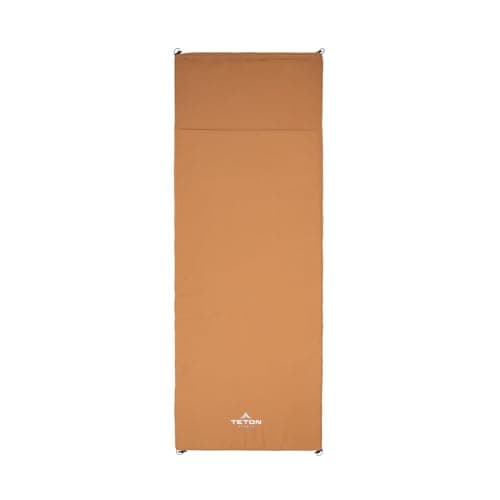
TETON Canvas Camp Pad (Universal XL)
Lifetime warranty7.9/10The only purpose-built cot pad we score: slip-resistant loops and straps that attach to the cot's end bars, 2 to 2.5 inches of foam, R 5.5 to 6.2 depending on size, in 285D brushed canvas with a removable cover and a limited lifetime warranty. The 82 x 38-inch Outfitter XXL version suits a 35-inch-plus deck.
$102.89Amazon#ad · Price as of October 10, 2026 · Disclosure for the link to TETON Canvas Camp Pad (Universal XL)
Best insulated pad for a cot
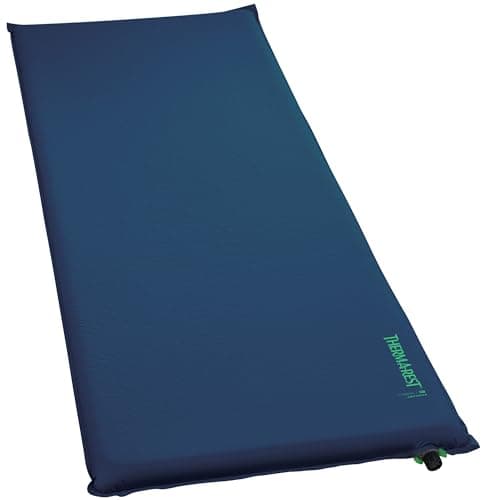
Therm-a-Rest BaseCamp Sleeping Pad (Large)
Lifetime warranty8.1/10The all-rounder: 2 inches of self-inflating foam at R 6 on a 75D polyester shell, 3 lb 6 oz in the 77 x 25-inch Large, with a WingLock valve, a limited lifetime warranty and a do-it-yourself valve repair kit sold by Therm-a-Rest. Made in 20, 25 and 30-inch widths.
$135.70Amazon#ad · Price as of October 10, 2026 · Disclosure for the link to Therm-a-Rest BaseCamp Sleeping Pad (Large)
Best overall camping mattress
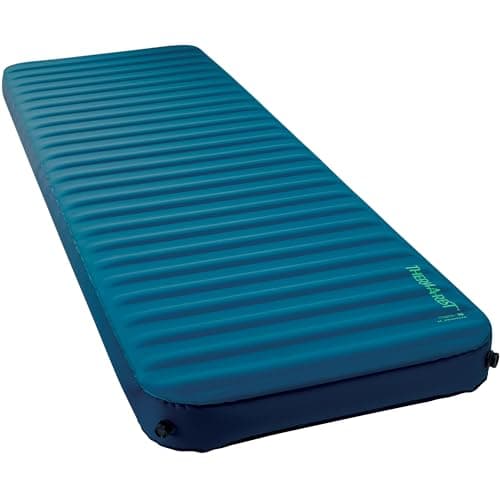
Therm-a-Rest MondoKing 3D Sleeping Pad (Large)
Lifetime warranty8.3/10The thick one, for side sleepers and complaining hips: 4.25 inches of StrataCore foam at R 7 with vertical sidewalls and a two-valve TwinLock system, in 77 x 25 and 80 x 30-inch sizes. Limited lifetime warranty; pump sack included.
$259.20Amazon#ad · Price as of October 10, 2026 · Disclosure for the link to Therm-a-Rest MondoKing 3D Sleeping Pad (Large)
- Stock photo
Best budget cot-width self-inflating pad
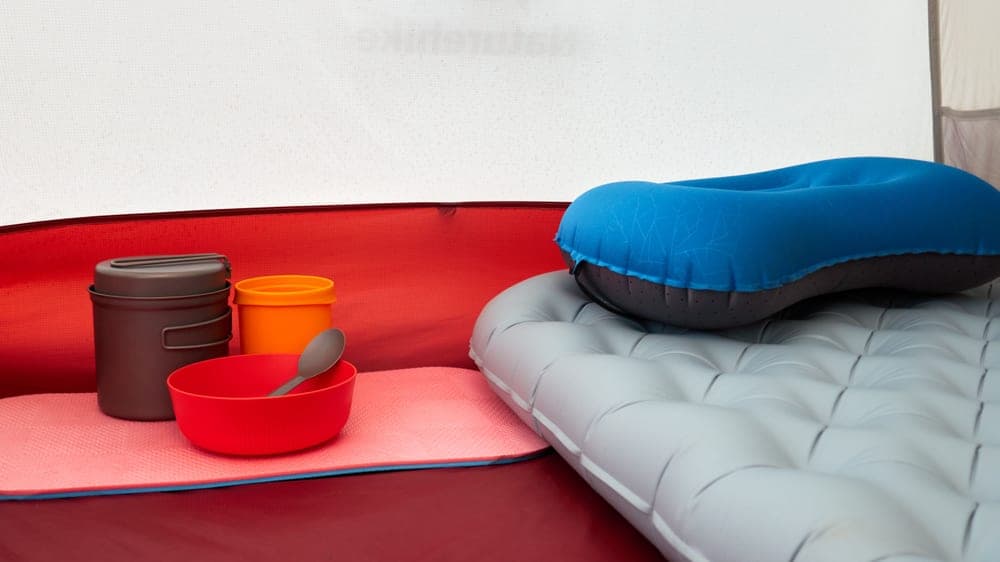
ALPS Mountaineering Flexcore Air Pad (X-Large)
Lifetime warranty6.0/10The budget pick: 2 inches of open-cell hexagon-cored foam at R 2.9 in a 77 x 30-inch XL, double brass valves, with compression straps, a stuff sack and a repair kit in the box — and ALPS's lifetime warranty behind it.
Check price on Amazon#ad · Price as of October 10, 2026 · Disclosure for the link to ALPS Mountaineering Flexcore Air Pad (X-Large)
Getting the most out of the pad
- Inflate a brand-new self-inflating pad fully and leave it 2 to 4 hours before first use. Therm-a-Rest's own instruction. It helps the foam recover its loft properly for the rest of its life.
- At camp, open the valve and walk away for a few minutes. Let the foam do the work, then add a couple of breaths at the end for firmness. You get a better, more even result than blowing it up from flat.
- Store it unrolled and inflated with the valve open, somewhere dry. Also Therm-a-Rest's own instruction, and the single biggest factor in how long a self-inflating pad keeps its thickness. A pad stored compressed in its sack for eight months loses loft permanently, and Therm-a-Rest notes that prolonged storage somewhere damp can cause mildew damage its warranty does not cover.
- Keep the repair kit with the pad, not in a drawer at home. ALPS ships a repair kit with the Flexcore, Therm-a-Rest sells Instant Field and Permanent Home kits plus a WingLock valve kit, and Exped sells a field repair kit. Leak repair is covered in how to fix a camping mattress leak.
- Let out a third to half the air in the heat of the day if the pad is sitting inflated in a hot tent — Therm-a-Rest's guidance, to stop heat expansion stressing the seams.
When the cot is the problem, not the setup
Three cases where no pad will save it. A deck that is too narrow — 26 inches is 26 inches. A deck whose fabric has stretched past tensioning, which is a parts question: TETON sells the cot top fabric bed, Disc-O-Bed sells 35 and 40-inch mats, ALPS sells a Ready Lite bed replacement and Helinox sells a Cot One replacement sheet, while Coleman's consumer care told us its cot canvas is not sold separately. And a cot whose centre bar sits exactly under your hip with no room to move, which is what Disc-O-Bed's no-centre-bar design exists to solve.
If you are replacing rather than fixing, the ranked options are in best camping cots, cots for side sleepers and cots with a mattress. The parts and spares picture across every brand is in cot replacement parts.
How we scored this
What goes into every pick
We read the maker's rated capacity, frame, fabric, dimensions and weight; quote the warranty from the maker's own warranty page with the date we read it; check whether seat fabric, cot canvas, feet, valves and legs are sold as replacement parts; and score all of it on a published rubric where durability and warranty carry half the weight. Every spec links to where it came from, and the live Amazon price sits in the button.
Scores are computed from that documented research with fixed bands, so two products are always measured the same way. Commissions never set a score or decide a pick. The rubric and its bands are published.
Corrections & updates
- First published. Pad care guidance read from Therm-a-Rest 2026-10-11; no product specs were changed.
Questions
Frequently asked
How do you make a camping cot more comfortable?
Put a foam-core self-inflating pad on it — that fixes the hard deck, the pressure points and the cold underneath in one move. Before buying anything, re-tension the deck properly, feel for the frame bars and sleep between them, turn around so your shoulders are not over a crossbar, and level the cot so it does not sag unevenly.
What kind of pad should you use on a camping cot?
A foam-core self-inflating pad, 2 to 4.25 inches thick, sized to within an inch or two of the deck width. Foam keeps some thickness if it loses air and grips the deck better than a pure air pad, which slides around. The TETON canvas camp pad is the only one we score that is purpose-built for a cot, with straps that attach to the end bars.
Why am I cold on a camping cot?
Because a cot has no insulation. Not one cot maker in our registry publishes an R-value, and TETON itself warns that air moving under a cot can pull warmth away as effectively as direct ground contact. The fix is an insulated pad: Therm-a-Rest rates the BaseCamp at R 6 and the MondoKing 3D at R 7, and TETON rates its own camp pad at 5.5 to 6.2.
Why does my camping cot sag in the middle?
Either the deck was never fully tensioned or the fabric has stretched. Take it down and set it up again, getting the last end bar completely home — TETON fits a pivot-arm lever to the Outfitter XXL precisely because that bar is hard to seat. If the fabric itself has gone, TETON, Disc-O-Bed, ALPS and Helinox all sell a replacement deck; Coleman does not.
How do you stop a pad sliding off a camping cot?
Use a foam pad rather than an air pad — foam has far more friction against the deck. The TETON canvas camp pad goes further with slip-resistant loops and straps that attach to the cot's end bars. Failing that, a fitted sheet over both cot and pad holds them together well.
How should you store a self-inflating cot pad?
Unrolled and fully inflated with the valve open, somewhere dry — that is Therm-a-Rest's own instruction, and it is the single biggest factor in how long the pad keeps its loft. Therm-a-Rest also notes that prolonged storage somewhere damp can cause mildew damage that the limited lifetime warranty does not cover.
Keep reading
Related on Seat & Stake
Receipts
Sources
- Therm-a-Rest (Cascade Designs) — Blowing It Up: How to Inflate a Therm-a-Rest Sleeping Pad (leave a new self-inflating pad fully inflated for 2-4 hours before first use; open the valve and let the foam do the work) (read 2026-10-11)
- Therm-a-Rest (Cascade Designs) — How to Store Sleeping Pads and Sleeping Bags (store self-inflating pads unrolled and inflated with the valve open, somewhere dry) (read 2026-10-11)
- TETON — Canvas Camping Pads (Adventurer Regular / Universal XL / Outfitter XXL) product page (read 2026-09-22)
- TETON Help Center — How do I attach my canvas camp pad to my cot? (read 2026-09-22)
- TETON Help Center — Can I purchase a new camp pad cover? (read 2026-09-22)
- TETON Help Center — Understanding R-Values for your TETON Camp Pad (read 2026-09-22)
- TETON — Warranty Policy (lifetime; Teton Everyday 90 days) (read 2026-09-22)
- Therm-a-Rest (Cascade Designs) — BaseCamp Sleeping Pad, Regular / Large / XLarge tech specs (read 2026-09-22)
- Therm-a-Rest (Cascade Designs) — MondoKing 3D Sleeping Pad, Large / XXLarge tech specs (read 2026-09-22)
- Therm-a-Rest (Cascade Designs) — Therm-a-Rest Warranty (limited lifetime; repair-first; fee-based repairs; repair videos and kits) (read 2026-09-22)
- Therm-a-Rest (Cascade Designs) — WingLock Valve Repair Kit (read 2026-09-22)
- Therm-a-Rest (Cascade Designs) — Instant Field Repair Kit (read 2026-09-22)
- ALPS Mountaineering — Flexcore Air Pad, Regular / Long / X-Large specs (read 2026-09-22)
- ALPS Mountaineering — Air Pad Repair Kit (Flexcore Repair Kit 7730083) (read 2026-09-22)
- ALPS Mountaineering — Warranty (life of the product; PVC Air Bed 1 year) (read 2026-09-22)
- TETON — Camp Cot with Pivot Arm (Outfitter XXL / XL / L) product page (read 2026-09-22)
- TETON Help Center — Can I Purchase Spare Parts for My Cot? (read 2026-09-22)
- Disc-O-Bed — Disc-O-Bed XL Single product page (read 2026-09-22)
- Disc-O-Bed Retail — 35" Disc-O-Bed Mat, XL (replacement sleeping mat) (read 2026-09-22)
- ALPS Mountaineering — Escalade Cot (Large / X-Large) product page (read 2026-09-22)
- ALPS Mountaineering — Ready Lite Cot Bed Replacement (read 2026-09-22)
- Helinox — Cot One Convertible Replacement Sheet (read 2026-09-22)
- Coleman — Trailhead II Camping Cot product page, incl. Coleman Consumer Care answers on parts (read 2026-09-22)
Specs and rated capacities come from the maker's own product pages (or a named dealer's copy when the maker's site blocked us), warranty terms from the maker's warranty page with the date we read it, and any third-party observation is attributed to whoever made it. Prices come live from Amazon with the date they were read. Where a figure isn't published, we say so and it scores zero. Read the full method.