
Why a cot feels cold
Most people buy a cot partly to get off the cold ground, so the first cold night on one comes as a surprise. TETON, which makes the cot we rank first, explains it in its own pad guide: “A cot lifts you off the ground, which helps, but air still moves freely underneath you all night, and that airflow can pull warmth away just as effectively as direct ground contact.” Its answer to whether you need a pad on a cot is “yes, especially once temperatures drop.”
A cot's bed is a sheet of fabric with open air beneath it, and none of the cots we score publishes an R-value for it. The other half of the problem is on top of the cot. Your sleeping bag insulates by trapping air in its fill, and your weight crushes the fill underneath you. Therm-a-Rest puts it plainly for someone lying on a bag with nothing under it: “The compressed down would fail to create an insulative layer between the two.” On a bare cot, the loft over you is working and the loft under you mostly isn't.
That's why staying warm on a cot is a question about what goes between you and the cot. The measure for that layer is R-value, which NEMO defines as “a measurement that reports how much a sleeping pad resists or prevents heat from flowing from a warm body and down to the ground.” TETON's guide adds that it works the same way against “cold air moving underneath a cot.”
How to stay warm on a cot: 7 steps
- Put an insulated pad on the cot. Choose it by R-value, not thickness. TETON: “a thick pad with a low R-value can still leave you cold, while a thinner, well-insulated pad can sleep warm even in cooler conditions.”
- Match the R-value to your coldest night. Plan for the lowest forecast, not the average. The makers' bands are in the next section.
- Add a closed-cell foam layer when it gets cold. R-values add up, so a foam pad under your main pad raises the total. Sea to Summit “strongly” recommends a closed-cell pad in addition to an air mat for winter.
- Keep the pad on the cot. Use a pad that fits inside the bed and fix it in place with straps or a sleeve, so you don't roll off your insulation at 3 a.m.
- Choose foam or insulated pads over plain air. An uninsulated air mattress on a cot is a second column of moving air, and it publishes no R-value to plan with.
- Block the draft under you. A cot-specific warmer layer, like the one Helinox sells for its Cot One, adds insulation that stays with the cot.
- Treat your sleeping bag's rating as a pad-plus-bag number. The ISO test behind most bag ratings puts a pad under the bag, so a bare cot leaves you short of what the rating assumed.
Steps 1 to 3 do most of the work. The rest of this page explains each one with the makers' own numbers.
How much R-value you need on a cot
There's no single industry chart that ties R-value to temperature, and makers draw their lines differently. Here are two makers' published bands side by side. Use them as a starting point and err warm on a cot, since TETON says the air under it pulls heat as well as the ground does.
| Conditions | Sea to Summit's suggested R-value | TETON's bands |
|---|---|---|
| Summer | 0 to 2 | R 1: warm weather, summer trips |
| Cooler weather, down to a light frost | 2 to 3 | R 4: three-season use, cooler nights |
| Cold weather, hard frost | 3 to 4 | |
| Winter | 4 or more | R 5.9 to R 7: cold weather, year-round |
Now the pads. The cot-friendly pads in our registry publish these R-values: Therm-a-Rest Z Lite SOL 2.0, ALPS Flexcore XL 2.9, Therm-a-Rest NeoLoft 4.7, TETON Canvas Camp Pad 5.5 (Universal XL) or 6.2 (Outfitter XXL), and Therm-a-Rest BaseCamp 6. One caution when you compare them: Therm-a-Rest's product pages cite the ASTM F3340-18 standard, which Therm-a-Rest says it helped develop so campers can “look at two or more sleeping pads and directly compare the R-value of each.” TETON and ALPS don't say whether their figures were measured that way, so treat a cross-brand comparison as approximate. Our camping mattress R-value guide goes deeper on the standard and on every pad we score.
Stacking pads, by the numbers
The cheapest warmth upgrade for a cot is a second pad. NEMO: “R-Value is additive, which means that you can use two pads and add their R-Values together.” Sea to Summit says the same thing in fewer words: “R-Value is cumulative.” Therm-a-Rest designs the Z Lite SOL for exactly this job and says you can “Add 2.0 R-Value and protection from punctures when you layer the Z Lite SOL under another sleeping pad.”
By that rule, using the makers' published figures:
- Therm-a-Rest BaseCamp (R 6) + Z Lite SOL (R 2.0) = R 8
- TETON Canvas Camp Pad, Universal XL (R 5.5) + Z Lite SOL (R 2.0) = R 7.5
- ALPS Flexcore XL (R 2.9) + Z Lite SOL (R 2.0) = R 4.9
Each sum is only as good as its inputs, and the TETON and ALPS figures don't state ASTM testing. The Z Lite SOL also has a practical advantage on a cot: it's closed-cell foam, so it can't puncture or deflate, and at 14 oz it costs almost nothing to carry. It's 20 inches wide, narrower than most cot beds, so it sits under your torso rather than edge to edge.
Keeping the pad on the cot, and the draft off you
Insulation only works while you're on it. Two things keep a pad in place. The first is fit: a pad should lie inside the cot's bed without hanging over the rails. Therm-a-Rest sells the BaseCamp 20, 25 and 30 inches wide; the Helinox Cot One Convertible's bed is 26 inches wide and the TETON Outfitter XXL's is 35.5 inches. TETON sizes each Canvas Camp Pad to the TETON cot of the same name.
The second is a way to hold it. TETON recommends attaching its Canvas Camp Pad “to the top and bottom bars of your cot ... with the included straps,” and the pad has slip-resistant loops for that. ALPS builds the answer into its Ready Lite Cot, whose “Two-layer top creates a sleeve for adding an air pad up to 2”” thick. On paper, a 2-inch pad such as the BaseCamp or the Flexcore is within that limit, though ALPS doesn't list compatible pads.
Some makers sell a layer made for the cot itself. Helinox's Reversible Cot Warmer is “A puffy sheet accessory for your Cot One” with “Two layers of spun polyester insulation for warmth and padding,” which Helinox says provides “draft protection,” held on by “Buckled straps under the cot.” It weighs 1.44 lb, Helinox publishes no R-value for it, and it fits the Lite Cot, Cot One Convertible and Cot One Convertible L, not the Cot Max, a difference covered in our Helinox Cot One vs Cot Max comparison.
What to look for in cot insulation
- A published R-value. Without one you can't plan a cold night. Prefer figures the maker ties to ASTM F3340, and treat the rest as approximate.
- Enough R-value for your coldest night. Use the bands above and err warm on a cot.
- Foam in the core. Self-inflating or closed-cell foam keeps insulating after a leak; our scoring gives foam-core pads a durability point for that reason.
- A size that fits inside your cot's bed. Check width first: 25 inches for most single cots, 30 inches for wide ones.
- Straps, loops or a sleeve to keep it in place when you roll over.
- A warranty and parts in writing. Therm-a-Rest, TETON and ALPS put lifetime terms on the pads and cot below, and Therm-a-Rest sells a do-it-yourself valve kit for the BaseCamp.
Pads and a cot that meet the bar
Our picks for this
Insulation with published R-values, and a cot that holds it
Three layers that publish an R-value and carry lifetime terms, plus one cot built with a sleeve to keep a pad in place.
- Stock photo
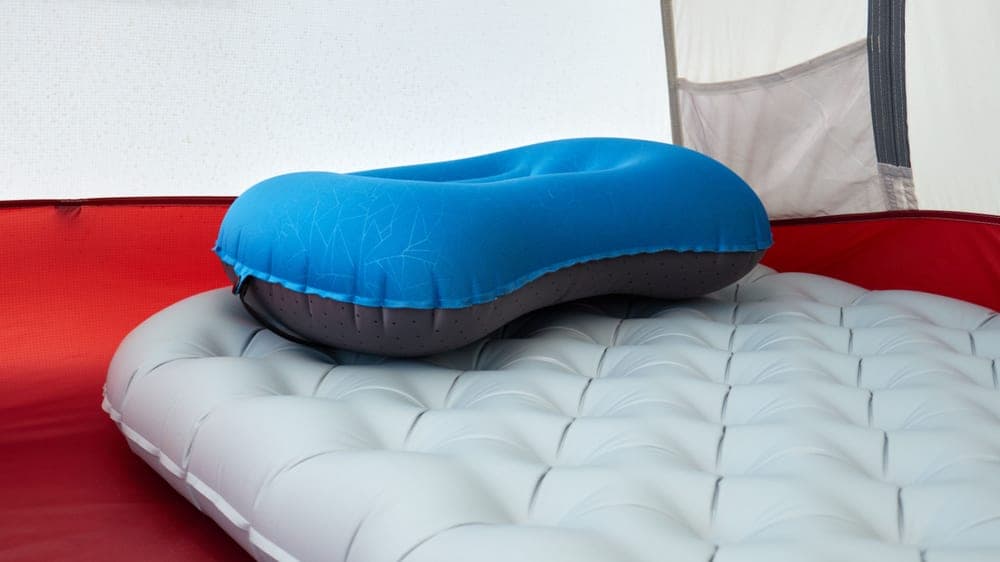
Best cot pad
TETON Canvas Camp Pad (Universal XL)
Lifetime warranty7.9/10R 5.5 (Universal XL; ASTM not stated) from 2 inches of foam in a brushed canvas cover that straps to the cot's end bars; lifetime warranty, and replacement covers are sold by email.
Check price on Amazon#ad · Price set by Amazon · Disclosure for the link to TETON Canvas Camp Pad (Universal XL)
- Stock photo
Best insulated pad for a cot
Therm-a-Rest BaseCamp Sleeping Pad (Large)
Lifetime warranty8.1/10R 6 (Therm-a-Rest cites ASTM F3340-18) from 2 inches of self-inflating foam; the XLarge is 77 x 30 inches; limited lifetime warranty and a do-it-yourself valve kit.
Check price on Amazon#ad · Price set by Amazon · Disclosure for the link to Therm-a-Rest BaseCamp Sleeping Pad (Large)
- Stock photo
Best closed-cell under-layer
Therm-a-Rest Z Lite SOL Sleeping Pad (Regular)
Lifetime warranty5.6/10R 2.0 closed-cell foam at 14 oz that can't deflate; Therm-a-Rest sells it as an under-layer that adds 2.0 R-value beneath another pad.
Check price on Amazon#ad · Price set by Amazon · Disclosure for the link to Therm-a-Rest Z Lite SOL Sleeping Pad (Regular)
- Stock photo

Best lightweight cot with a lifetime warranty
ALPS Mountaineering Ready Lite Cot
Lifetime warranty7.2/10A 5 lb cot rated to 300 lb by ALPS whose two-layer top forms a sleeve for a pad up to 2 inches; lifetime warranty and a replacement bed sold by ALPS.
Check price on Amazon#ad · Price set by Amazon · Disclosure for the link to ALPS Mountaineering Ready Lite Cot
If you're buying one thing, make it the pad: the TETON pad for a TETON cot, or the BaseCamp for most other cots, with the Z Lite SOL underneath when the forecast drops. The TETON pad (7.9) and the BaseCamp (8.1) score within 0.3 of each other on our mattress rubric, so choose on fit. For every pad ranked for use on a cot, see our best cot pads. Still deciding whether you want a cot at all? Our cot vs sleeping pad comparison weighs the two, and our best camping cots rank the frames themselves. Everything else for cot sleepers is in the camping cots hub.
How we scored this
Products we claim to have tested: 0
Plenty of sites say they sat in every chair on the list for a season. We don't say that, and we say so on every page. What we do instead: read the maker's rated capacity, frame, fabric, dimensions and weight; quote the warranty from the maker's own warranty page with the date we read it; check whether seat fabric, cot canvas, feet, valves and legs are sold as replacement parts; and score all of it on a published rubric where durability and warranty carry half the weight. Every spec links to where it came from.
Scores are computed from that documented research with fixed bands, not lab results. Commissions never set a score or decide a pick. The rubric and its bands are published.
Questions
Frequently asked
How do you stay warm on a cot?
Put an insulated pad with a published R-value on the cot, add a closed-cell foam pad under it on cold nights (R-values add), and strap the pad in place. Air moving under a cot pulls heat away, and a sleeping bag's fill compresses flat beneath you.
Why is sleeping on a cot so cold?
Because air circulates under it. TETON says that airflow “can pull warmth away just as effectively as direct ground contact,” and none of the cots we score publishes an R-value for its bed.
Is a sleeping bag enough on a cot?
Usually not in cold weather. Your weight compresses the fill underneath you, and the ISO 23537 test behind most bag ratings places the bag on an R 4.8 pad. On a bare cot, you have less insulation beneath you than the rating assumed.
Should I use foam or an air mattress on a cot?
Foam or an insulated pad with a published R-value. Self-inflating and closed-cell foam keep insulating if they leak. Sea to Summit explains that air inside an uninsulated mat moves and carries heat away.
How do I keep my pad from sliding off my cot?
Use a pad that fits inside the bed, then strap it down. TETON recommends strapping its Canvas Camp Pad to the cot's top and bottom bars, and the ALPS Ready Lite Cot has a built-in sleeve for a pad up to 2 inches thick.
What is a cot warmer?
An insulated sheet made to fit a specific cot. Helinox's Reversible Cot Warmer uses two layers of spun polyester insulation, weighs 1.44 lb and buckles under the cot; Helinox publishes no R-value for it and lists it for the Lite Cot, Cot One Convertible and Cot One Convertible L.
Keep reading
Related on Seat & Stake
Receipts
Sources
- TETON — Camping Cot Mattress & Sleeping Pad Buying Guide: Choosing the Right Sleep Surface (Rachelle Leann, September 2026) (read 2026-09-22)
- Therm-a-Rest (Cascade Designs) — What is R-Value? (Keith Erps, July 25, 2023) (read 2026-09-22)
- Therm-a-Rest (Cascade Designs) — ASTM Standard R-Value: Rating Sleeping Pad Insulation (read 2026-09-22)
- NEMO — New Standardized R-Value: NEMO's Involvement in and Approach to ASTM F3340 (read 2026-09-22)
- Sea to Summit — How to Choose a Sleeping Pad (R-value bands by season; R-value is cumulative) (read 2026-09-22)
- Sea to Summit — The Physics of Insulation and Comfort in Air-Filled Sleeping Mats (read 2026-09-22)
- Backpacking Light — Standards Watch: Sleeping Bag Temperature Ratings (ISO 23537 test setup; Rex Sanders, September 22, 2020) (read 2026-09-22)
- TETON — Canvas Camping Pads (Adventurer Regular / Universal XL / Outfitter XXL) product page (read 2026-09-22)
- TETON Help Center — Understanding R-Values for your TETON Camp Pad (read 2026-09-22)
- TETON Help Center — How do I attach my canvas camp pad to my cot? (read 2026-09-22)
- TETON Help Center — Can I purchase a new camp pad cover? (read 2026-09-22)
- TETON — Warranty Policy (lifetime; Teton Everyday 90 days) (read 2026-09-22)
- Therm-a-Rest (Cascade Designs) — BaseCamp Sleeping Pad, Regular / Large / XLarge tech specs (read 2026-09-22)
- Therm-a-Rest (Cascade Designs) — NeoLoft Sleeping Pad, Regular / Regular Wide / Large tech specs (read 2026-09-22)
- Therm-a-Rest (Cascade Designs) — Z Lite SOL Sleeping Pad, Small / Regular tech specs (read 2026-09-22)
- Therm-a-Rest (Cascade Designs) — Therm-a-Rest Warranty (limited lifetime; repair-first; fee-based repairs; repair videos and kits) (read 2026-09-22)
- Therm-a-Rest (Cascade Designs) — WingLock Valve Repair Kit (read 2026-09-22)
- ALPS Mountaineering — Flexcore Air Pad, Regular / Long / X-Large specs (read 2026-09-22)
- ALPS Mountaineering — Ready Lite Cot product page (read 2026-09-22)
- ALPS Mountaineering — Ready Lite Cot Bed Replacement (read 2026-09-22)
- ALPS Mountaineering — Warranty (read 2026-09-22)
- Helinox — Cot One Convertible product page (read 2026-09-22)
- Helinox — Reversible Cot Warmer accessory page (read 2026-09-22)
- TETON — Camp Cot with Pivot Arm (Outfitter XXL / XL / L) product page (read 2026-09-22)
We don't claim to have tested, owned or sat in these products. Products we claim to have tested: 0. Specs and rated capacities come from the maker's own product pages (or a named dealer's copy when the maker's site blocked us), warranty terms from the maker's warranty page with the date we read it, and any third-party observation is attributed to whoever made it. Amazon prices change often, so we don't print them. Where a figure isn't published, we say so and it scores zero. Read the full method.